

Today was our first day of language learning as we enrolled in the Chinese Language Education (www.chinaledu.com) of Beijing. It is a top-rated Mandarin language institute that has taught diplomats, business professionals, and educators and their families for several years. It is a results-oriented program. Instruction includes reading, writing, speaking, communicating, and grammar.
This was our first day, but already, we are impressed with the quality of both our instructors and the program. In just four hours, we covered the Pinyin system and its 21 initials, 36 finals, and 4 tones (plus neutral). We spent a good deal of time of correct pronunciation of a selection of basic initials (syllables) and simple finals (vowels) with correction tones (inflections). We also learned the 6 basic stories and 22 compound strokes, their names, and the correct order to make them (L-R, Top-Bottom). We were introduced to a set of useful vocabulary words, both in pinyin and in Chinese simplified character, along with basic dialogue structures to practice for homework.
The website has plenty of information on the institute, but we were first introduced to the owner/founder two years ago and were impressed. We also learned of people who gave very positive testimonials of the staff and program. We are glad to be part of it.
We have finally completed the process with the provincial government and local authorities to secure my wife’s alien worker’s permit, health permit, work VISA, and residency permit as a professional educational consultant to Mei Wen, Inc., a fledgling Chinese hybrid social enterprise that focuses on both for profit ventures and nonprofit service to the rural student. My wife’s permits and VISA are good for three years, but renewable in one-year increments. This is the culmination of many letters of invitation, supporting documents substantiating the need for a foreign worker/expert, work vitae and notarized educational diplomas and additional certification of passport and government approval. Each process required different forms and application process, a health screening, and interview. Without the help of our Chinese Mei Wen colleagues, this would have been impossible. Fortunately, only one work VISA is required for a couple. The next step is to change my tourist VISA to a spouse VISA designation. My tourist VISA is valid for 10-years, multiple entries, 60-day durations. This will require additional documentation and application process, without which, I will need to leave the country and reenter after 60-day stints.
We now have permission to travel to Beijing to being our formal instruction in the Chinese language for the next six weeks. We are very excited. The VISAs allow us to enter the country, but language study allows us to enter the culture and make friends.
We have reached a stage of culture shock, after 30-days of being in country during the Spring Festival celebrations, in which we were largely inept in communicating even basic needs because of our lack of Chinese language skills. Now we can attempt to let go of our ethnocentrism and cultural biases and start to embrace a new culture and new way of living and being as we transition through the doorway of language into a new level of understanding and inquiry. (You can only accomplish so much through eating the food).
We leave tomorrow for Beijing!
We would like to thank our hosts, Coco and Kiki (and their parents), for welcoming us into their Spring Festival celebration. They live in Xinyang, Henan, but they grew up in a small village to the NW of Xinyang, about a 45-minutes drive. It was a beautiful experience, one for which we are deeply grateful. It reminds us of how Americans celebrate Christmas. In China, people make the effort to return home, to their places of origin, to reconnect with family and the land. In the last 30 years, China’s industrialization initiatives have produced more jobs in the cities, but at the expense of depleting its human work force in the countryside. People are moving out of the country and into the cities where there are jobs. The results are diminished villages as China becomes less agrarian than it was.
This experience hearkened back to simpler days: the house had electricity and a well and gravity plumbing. The nights were cold and we slept in all of our clothing (us in our sleeping bags) under a mound of blankets. Yet, the hearts of the village people were warm and inviting. The morning after, the tradition is for neighbors to welcome each other with a glass of hot green tea and to offer some sunflower seeds, peanuts, pine nuts, or watermelon seeds, and occasional sweet — or even better, a slice of sugar cane!
We watched a beautiful, four-hour pageant show on CCTV 1, which featured drama, singing, and choreography with feats of athleticism, precision, and balance. Though there was no English captioning, we were able to recognize famous personalities from Chinese films and billboards. It was a count-down gala event to midnight, when the skies erupted with lightning and sounds of thunder as every household across China, in villages, towns, and cities, ignited their fireworks at the same time. WOW!! It was an incredible, unforgettable experience. Thank you!

Our host’s front entrance to their village compound
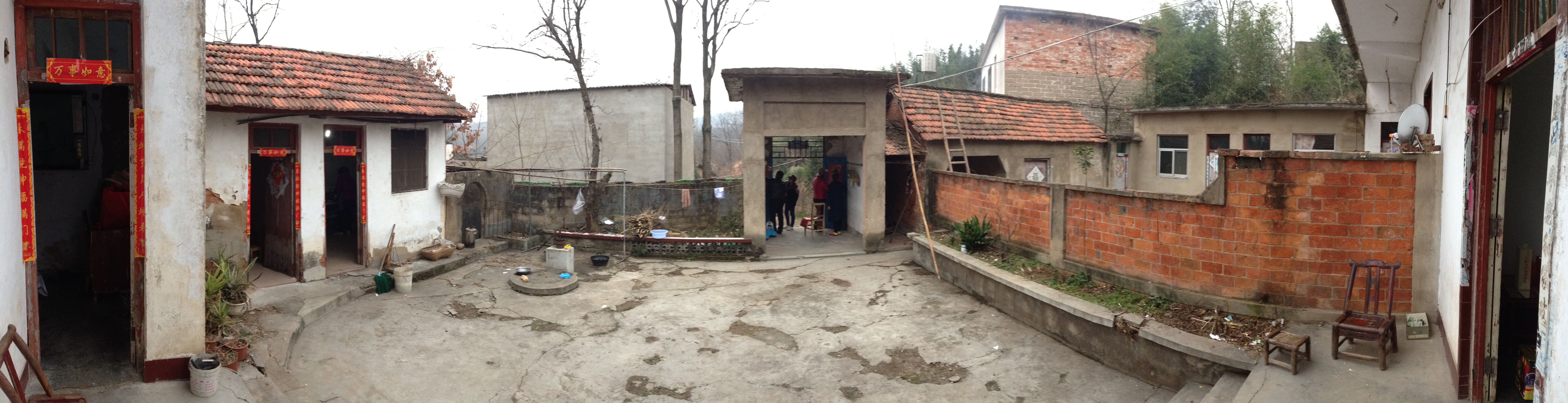
The view from the porch looking at the front entrance

Traditional Rites Observed – Altar to Ancestors
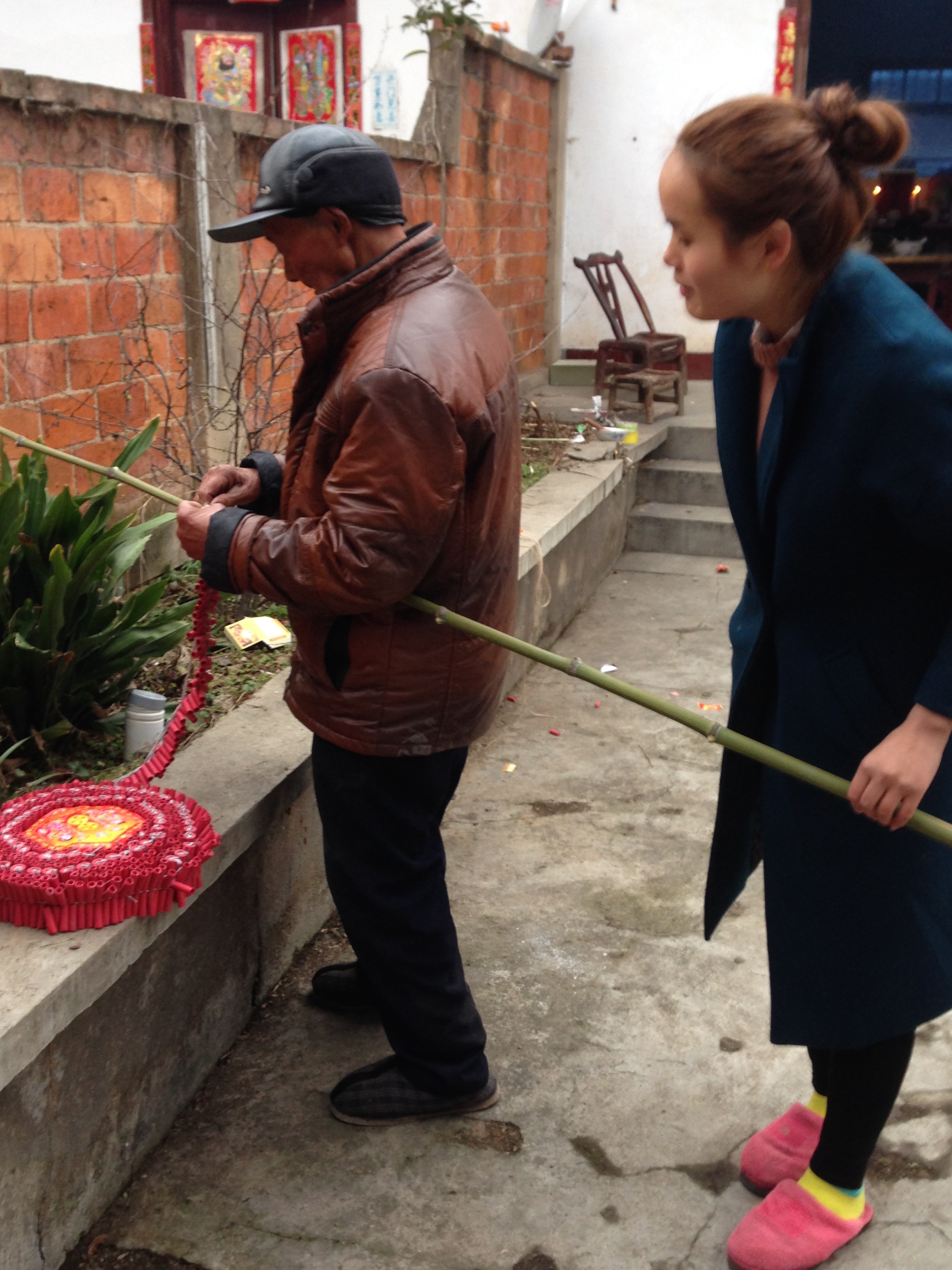
Requisite Fireworks to Announce Celebrations
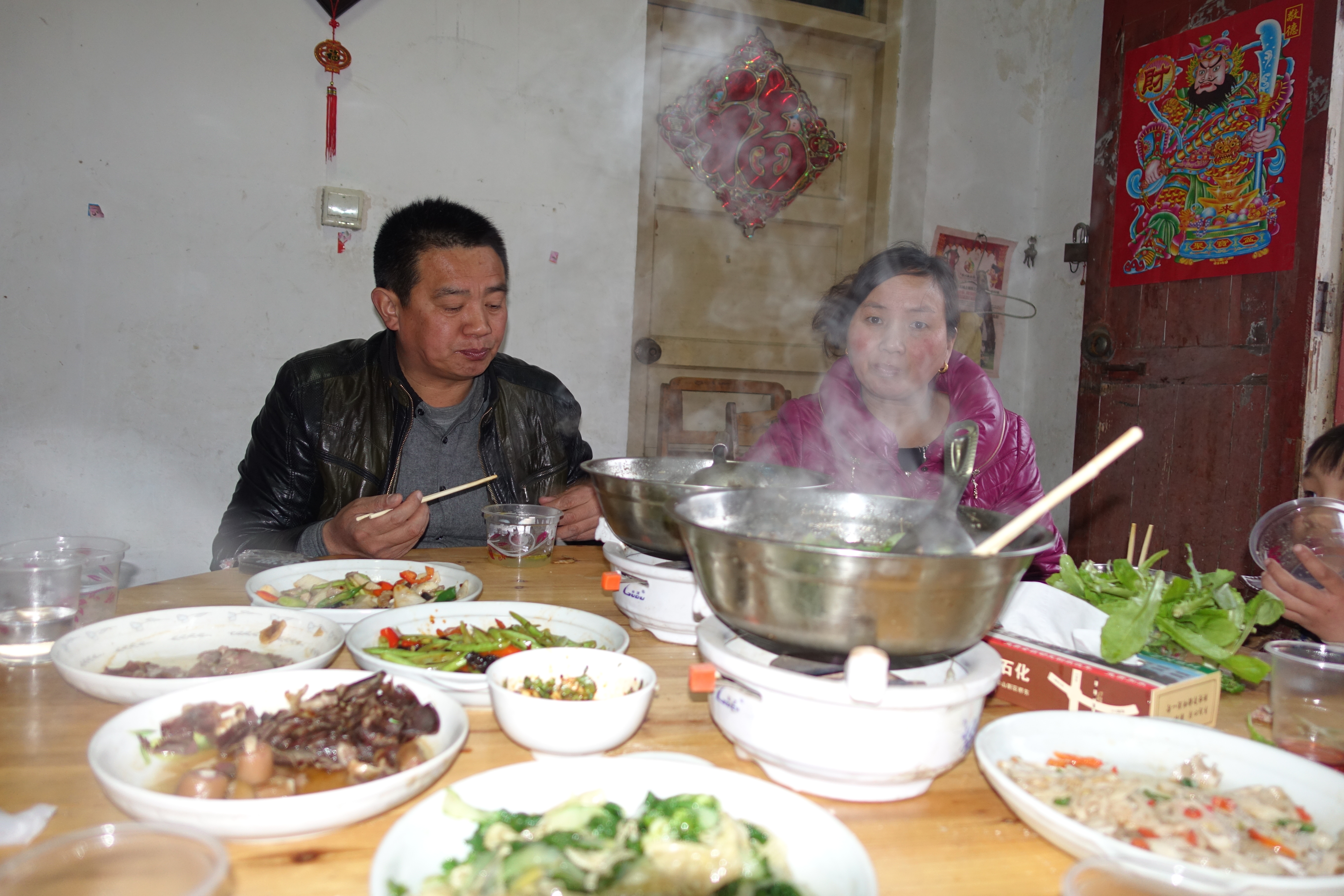
Traditional Reunion Meal featuring fish soup
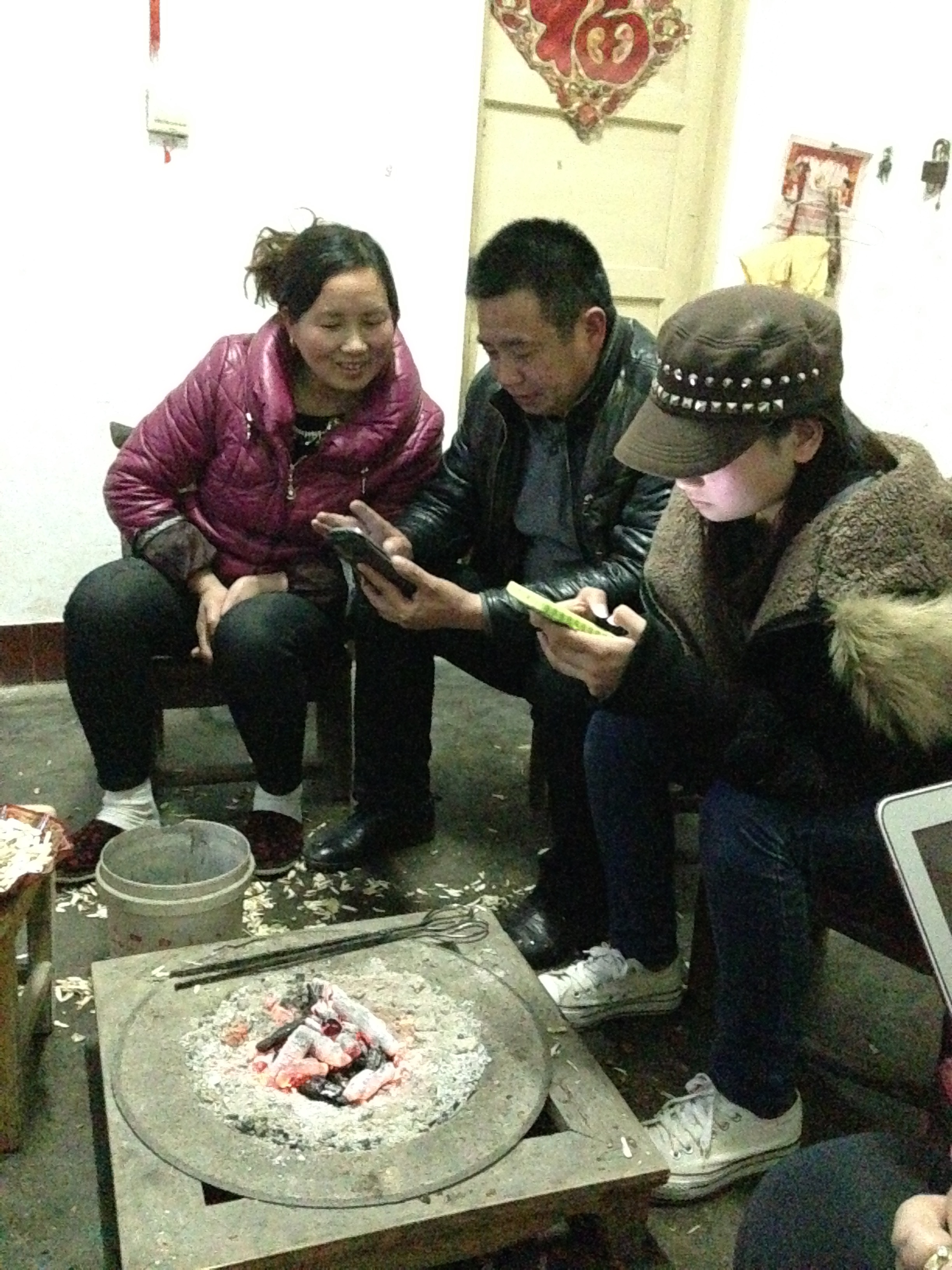
Keeping warm after the meal with coal briquettes

Preparing the traditional New’s Day Breakfast with Dumplings (Jiaozi).

What makes a home? Family!

Fireworks to welcome in the New Year of the Sheep 2015!

Feb. 18, 2015 marks the beginning of the Chinese New Year. 2015 is the Year of the Sheep. Today is also Ash Wednesday in the 2015 Liturgical Calendar of the Church, which began with the season of Advent on Nov. 30, 2014. The Gregorian calendar celebrates the New Year as beginning on Jan. 1st.
The streets of Xinyang are relatively quiet for a city. Bus and Taxi services are still running, the lifeblood of the city. The main markets are closed. I can hear a street sweeper nearby broadcasting “Happy Birthday” to alert pedestrians and motorists of its presence.
Whether we mark time by the moon or the sun or change in seasons, may this new approaching time cycle in your life be full of God’s love, joy, and peace.
Happy New Year!
Spring Festival, aka Chinese New Year is Feb. 18th this year. There is a lot of buildup anticipating this event. Lot’s of food preparations for special meals. I’ve enclosed a couple of photos of men waiting for the same bus we took. One has a leg of lamb, the other has two, live roosters. It makes sense. It’s just not what I am accustomed to seeing on a bus.
-

- img 2166
-

- img 2167
-

- img 4709
This is our favorite potato “Christmas Tree” vendor. The tree is one, delicately, spirally sliced potato, dipped in special flour/egg batter, deep fried to golden perfection and sprinkled with special herbs and spices. And, of course, the requisite four striped slather of ketchup — all on one, long bamboo skewer! The thinness of the slice makes it a hybrid somewhere between one very long french fry and one very long potato chip. We are not sure how to eat it. If you eat it like boiled, corn on the cob, you will get ketchup on your face somewhere. If you pick at it, tearing off pieces, remember it is one slice. Some pieces may crumble and fall. Be aware, too, of ketchup drip. One thing is for sure, always stand upwind to avoid ketchup splatter and be sure to get some napkins. They aren’t offered with the product, so you may have to ask for them or bring along your own supply.
This time a side story was developing. Whenever we stop at vendor, we usually attract a small crowd. What do the Americans think is so good? What are they eating? A woman stops with her white dog. My wife is a dog lover. She starts interacting with the dog, talking to it and tussling with it. The owner is initially pleased, but soon the dog wants to play and talks back (dogs bark when they get excited and playful). The woman wanting to hush the dog decides to buy the vendor’s deep-fried chicken item on the menu. She offers the dog first bite, but is sniff and licks and decides “no.” The woman almost absent-mindedly puts the piece in her mouth, but checks herself at the last minute and asks the vendor for an additional skewer, one for her and one for the dog. The dog, however, is not interested in the food. It wants to play. She is having troubled handling the dog in one hand, her purse, and the food with skewers in the other. She becomes flustered and makes some remarks (in Chinese) to the vendor, which I guess is something like: “He doesn’t like your food. Hey, what kind of food are you selling? Is the meat bad? I want my money back.” He laughs and holds up both hand and replies (also in Chinese), and, again, I’m guessing something like, “No the meat’s good. All sales are final. I have lots of happy customers.” I think, however, that there must be lots of MSG in the seasoning and spices and the dog just wanted to eat natural.
So, as this dialogue is happening, I’m hurriedly trying to video all this on my iPhone, because the vendor is about to hand us our potato “Christmas Tree.” Suddenly, I hear Mim say behind me, “Better watch out, the dog wants to pee.” So, I look down to locate the dog, at the same time the owner is handing me the finished product. I’m trying to stop the video on my iPhone with one hand while balancing the precious potato “Christmas Tree” in the other, hoping not to drop it, while trying to locate the dog so that he doesn’t pee on my shoes. I turn to give the product to Mim who has back away and I momentarily forget to pay the vendor, my hands and attentions full with other things.
I go back to pay, just as the dog quietly saunters over to the corner front, raises his leg and pees on the front of the vendor’s store, which is a roll-down, steel box (like for storage) container, except with upgrades for electricity, machinery, counter-tops, and even wall papering. All the businesses are equipped like these. Was the dog excited and just needed to pee or did it just post his review of the product — like putting it on YELP — for future reference?
Without language training and a cultural guide we are still trying to decode the everyday scripts people say and use when they interact with each other, like purchasing a potato “Christmas Tree” or interacting with dog culture or business culture. It can be fun and frustrating at the same time.
-

- img 4727
-

- img 4734
-

- img 4729
Feb. 9, 2015
Today we went to Zhengzhou to complete the requisite medical exam for my wife’s work VISA. You need to be at the facility before 11:00 a.m., since the process takes 1 hour and all the doctors and nurses call it quits at 12:00 noon.
We took the G train, a fast train, from Xinyang. The ticket price was about 148 CYN. (The exchange rate is 1 USD : 6.1 CYN). It is a bit of an extravagance, considering most of China travels on slower train. The trip took about 90 minutes and the cost was similar to buying a small tin of famous Xinyang black tea. We took the subway from the train station and then walked about 2 km to the medical facility.
There were a lot of Chinese men getting their exam. Evidently, workers need exams when they cross provincial boundaries or work out of country. (I need to verify the provincial boundary requirement).
We met a friend of the family (our colleague, Yang Guang) for coffee. She is a computer science teacher in Zhengzhou but is recently returned on holiday from a special, one-year, school-sponsored, leave of absence assignment to teach middle schoolers in a poor rural village called Dancheng in Henan Province. A village which progress and modernization have seemingly forgotten. She lives in a one room apartment where she does her cooking. There are only dirt roads with poor drainage during rain season and there is no heat in either the one-room apartment or the school. In fact, the school room has no glass panes on its windows. The kids are exposed to the elements from the outside. There is no heat. The walls consist of deteriorating brick and plaster and broken concrete flooring with chalkboards. The children, however, are so grateful to have a teacher in their one-room school house.
Her story greatly encouraged and inspired us. We, too, are here to offer our services and expertise to children in rural areas surrounding Xinyang. Both my wife and I are teachers. I was glad that Chinese hearts are also moved by the plight of their own countrymen and are doing something about it. Her example has challenged our own thinking regarding the USA. What if we all gave 1-year of service to the rural or urban poor? Could we make a difference? Or, is this just a fairytale dream? Fu Juan, the woman teacher, is doing it to become a better person and to serve her country. This, I think, is a new definition of patriotism.
We are back at the hotel, each of us struggling with colds. We have not been in the country for even a week, and, already, there is so much to tell.
– Jeff & Mim
-

- img 46731
-

- img 46761
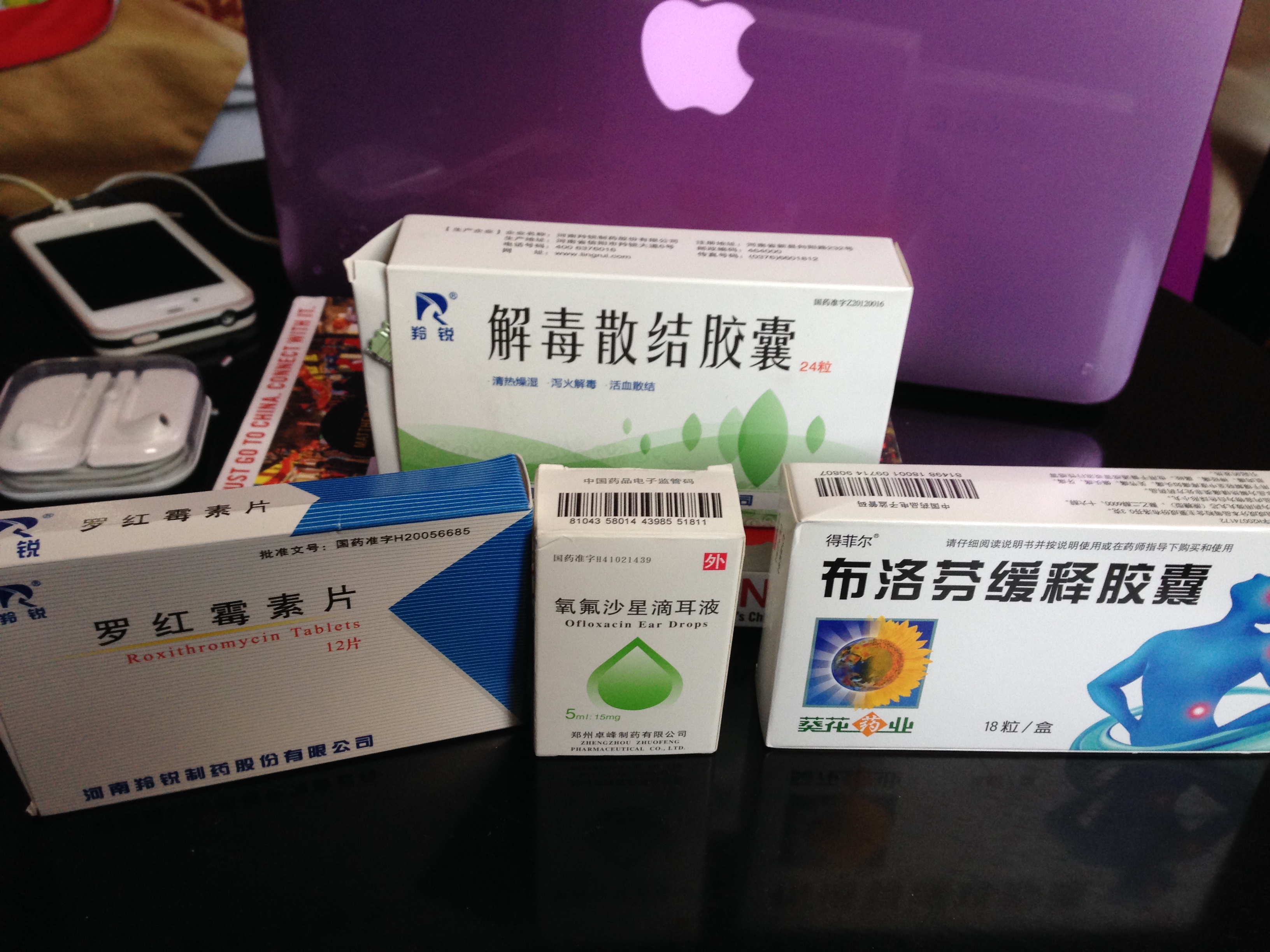
My first hurdle: navigating the local pharmacy for what I need to take care of myself.
Within a week of our arrival, I developed an ear infection with flu-like symptoms. Fortunately, pharmacies abound in Xinyang. The local brands are Watsons and Meirui. Accompanied with my wife and an ex-pat friend who works here as a ESL teacher and armed with my iPhone 5 and her iPad and Pleco (an amazing Chinese dictionary app) and no working knowledge of Mandarin, we played charades, gesticulating widely with exaggeration to give context for the situation and then point to the Pleco translation. I was able to find ibuprofen, whose Chinese equivalent is buluofen. That sounded like a cognate and the picture on the box illustrated pain centers. Ear Ache is ertong. (There are proper tones, which if not correctly pronounced will change the meaning of the word, but we did get the point across). Ear Wax was trickier and we decided not to attempt it, because the Chinese character has several meanings: stool, feces, ear wax, or nasal mucus. We just did not want any misunderstanding. Getting an antibiotic was a little more challenging, but the Pleco translation delivered kangshengsu or kangjunsu, (sorry for no tones) which fortunately the pharmacists recognized. I was even able to get ear drops! A day later when we were able to meet up with a Chinese friends whose English is good, we compared notes. He was worried that we had purchased the top middle, which was Chinese medicine, to rid the body of toxins and restore natural balance. I had taken a couple of tablets desperate for relief, which also worried him then me and taught me an important lesson: always check with your doctor before you take any medication. I am taking some rest days to recover before we go out to explore the city. This time will give me opportunity to learn some spoken Chinese.

Government funding for small business loans have recently created a plethora of coffee houses in China. Each business features a rustic, industrial design decor with a potpourri of boutique furnishings like chandeliers and British telephone booths and books — all of which makes no rationale sense except the entire experience is niche.
 dxeph528
 Bamboo Pilgrim